Friday, October 27, 2017

Jan Garbarek Group - "Photo With Blue Sky, White Cloud, Wires, Windows And A Red Roof" (1979)


It's fun that the title perfectly reflects the cover, and that each song title is part of the photo. It impressed me, at least. But in general, I'm no jazz pundit, so this album isn't really for me. I have a CD with the Norwegian Garbarek, where he plays his saxophone to the heavenly voices of The Hilliard Ensemble, which made me curious how he would sound more on his own. The record was found in a local record store here in Montreal recently.

The basic problem is, as mentioned, I'm not a jazz lover. I have never really understood jazz, despite some semi-committed efforts. I often experience jazz as too unstructured and that I never really understand where the music is going. Or it's way too messy and loud. Jazz is simply not my thing.


Another problem is that I often experience the saxophone in some musical contexts, and especially the soprano saxophone which Garbarek often plays, on the border to cheesy. Perhaps I've heard too many Lionel Richie songs from the 80's with the soprano sax. It affects the experience concerning today's album, sometimes it becomes cheesy jazz in my ears. The sound on the album is airy and clear, which appeals to me, this is no smoky jazz club or a crazy bebop dance floor. And we're not on a visit to the jazz avant-garde world. No, it's not difficult jazz Garbarek offers, and the musicians are of course talented, as jazz musicians usually are. When you turn the album to side B, it feels like the music gets a bit more difficult, as if the first side was a warm up. But still relatively accessible jazz.

I don't mind the record spinning on the turntable, I don't dislike it. But I can't sit and listen attentively to it, then I get bored. As cool background music it's perfect, and I can for once feel jazzy intellectual. I say like the pros on allmusic,com: Nothing too exciting occurs, but this is high-quality background music.


Tracklist

Side A
1 Blue Sky 6:44
2 White Cloud 9:03
3 Windows 6:44

Side B
1 Red Roof 7:48
2 Wires 5:18
3 The Picture 8:05


Thursday, October 26, 2017

Evabritt Strandberg, Fillie Lykow & Jan-Olof Strandberg - "En Sång, Ett Vapen" (1965)


In Sweden, Evabritt Strandberg is probably more famous as an actress, but she has also performed a lot as a singer, and in 1995 she received the Cornelis Vreeswijk scholarship, which is a pretty big thing. En Sång, Ett Vapen (A Song, A Weapon) was her debut album. I have no clue regarding who her fellow musician are. I'm pretty sure this was another album I saved from my parents' collection when they were about to get rid of it.

The record sleeve doesn't contain much information, except the song titles and that the price was 9.75 Swedish kronor (a little more than $1). On some pics I've seen online, there has been a text sheet with the album, where there is probably more information about the album and its content. It's a lack of facts shared online on this LP, so my knowledge is very limited. At least we know the year was 1965 and Franco had the power in Spain, which the whole record is a big protest against. Each song is about Spain and the political situation there, and between each song, either Evabritt (I suppose) or one of the male musicians read a text on the subject. It can be some kind of story, sometimes almost poetry / prose. In a way it's interesting, since it's a relatively unusual layout on a record, today.

What do you know, the price had gone up here!

The music is quite simple, it's songs accompanied by a sole guitar, sometimes there is a trumpet and some kind of percussion, and somewhere a flute is heard. The tempo is calm, as it usually is in trubadur songs. But this is not a record in my taste from a musical point of view. Pretty boring songs and a primitive sound. It's been a long time since Franco disappeared from the earth, so that specific battle is over, but as a time capsule the record may be a little interesting. The fact that fascism is still around today, perhaps not exactly in the form that Franco represented, is of course another question. Maybe new protest albums would be needed today on the subject, with groovier songs and a better sound, I hope.

Since I primarily listen to music for musical enjoyment, this is not an album I will play in the future, nor can I recommend it with a good conscience. Sure, the message and the fight are noble, but I get pretty bored by the music and the texts that are read. And that lots of songs are repeated on the record doesn't make things better.


Tracklist

Side A
1 Natten Är Svart
2 Den Svarta Tuppen
3 Blommorna I Madrid
4 Frihet
5 Jag
6 Mordet I Katedralen
7 Ur Akrobat I Luften
8 Vaggvisa
9 Ur Om Jag Skall Vara Uppriktig

Side B
1 Sången Om Julian Grimau
2 Bokslut
3 Natten Är Svart
4 Den Svarta Tuppen
5 Blommorna I Madrid
6 Mordet I Katedralen
7 Vaggvisa
8 Sången Om Julian Grimau

Wednesday, October 25, 2017

Dr. John, The Night Tripper - "The Sun, Moon & Herbs" (1971)


This was the witch doctor's fourth album, and despite the voodoo dripping swamp blues from the American south, the album was recorded in London. I suspect the geographic location is to thank for Eric Clapton's and Mick Jagger's presence on the record. According to the info on the cover, Clapton is heard on slide guitar, while Jagger joins the backing vocals.

This album is filled with voodoo mysticism, but much of the theory is beyond me, as I'm relatively ignorant on the subject. Dr. John, aka Malcolm John Rebennack, used a lot of voodoo inspired content on his first albums and shows, how much this was just an image, I can't really say, but he seemed to have real interest and involvement in the scene.


The Sun, Moon & Herbs is a cool album. Generally, I'm not a blues guy, but Dr. John's dark version appeals to me, with its spices of mysticism and psychedelia. The songs moves between Dr John's raspy voice and the female backing vocals which answer him. They complement each other, the doctor's voice puts the listener in a hypnotic state, and the female choirs then pull the line in and you're lost. With the doctor as guide, the listener is taken on a journey to the darkest and most secret places of the South. With you on the trip is his groovy wind section, which also puts its mark on many songs.


The songs are relatively long, in most cases that's OK since it's a relatively hypnotic mood that is generated; it's often positive to let this last for a while. But a couple of songs are somewhat boring, so they would gain in being a bit shorter. Dr. John's idea was that this was going to be a triple album and was never really satisfied with the single record format. Personally, I think this format is good, on a triple (or double) album, there's a risk that there will be too much filling. You don't get that now. After this album, the doctor left the voodoo mysticism and began to lean more towards traditional New Orleans R & B.

So, I recommend letting Dr John throw his spells on you via the stereo, the mobile phone or whatever you use to listen to music. But it's probably an album that doesn't suit everyone, it's not radio friendly Max Martin pop. It's best played on a dark, humid night, when the sweat is dripping, dark spirits roam the streets and insanity lures around the corner.


Tracklist

Side A
1. Black John the Conqueror 6:20
2. Where Ya at Mule 4:56
3. Craney Crow 6:40

Side B
1. Familiar Reality (Opening) 5:25
2. Pots on Fiyo (Filé Gumbo) / Who I Got to Fall On (If the Pot Get Heavy) 5:48
3. Zu Zu Mamou 7:57
4. Familiar Reality (Reprise) 1:53


Tuesday, October 24, 2017

Camel - "Nude" (1981)


The British band Camel has always been one of my favorite bands from the progressive genre. Their music is relatively easy to access, not too complex and complicated compared to some other bands from the genre. But still something of a challenge for the listener, at just the right level. But when I first put Nude on the turntable, I was horrified. The record opens with a song that sounded like a really cheesy 80's pop song. And the next one sounded about the same. Then I turned off the turntable, put the LP in the shelf and left it there unplayed for many years. That's how disappointed I was. Did the 80's even succeed in corrupting Camel?

When I later on read a few reviews online concerning the album, I was surprised that it got so high grades, often 4s or 5s (on five-grade scales). I decided to give it another chance. Nude is a concept album about the Japanese soldier who remained on an island for many years, believing that WWII was still going on. The soldier was Hiro Onoda, and "Nude" derives from his family name. This was the eighth record from the band and the last one where the drummer Andy Ward participated, he later left the group due to a serious hand injury. It's unclear to me who were members in the band at the time, and who participated as studio musicians on the album, but on saxophone Mel Collins, a giant in the prog genre, is heard.


When I gave the album a second chance, I realized that it actually contained some qualities. Most songs are instrumental, luckily enough, as the few tracks with song are not good at all. OK, Drafted is actually nice, but it's more of an ordinary pop ballad than prog, the other tracks with song are the horrific cheesy 80's pop mentioned in the beginning. Lionel Richie class. The instrumental songs are, however, a bit more as one is used to hear Camel, guitars in harmonies, lots of flute and lots of saxophone. Some odd time signatures. But it's far from the quality the band had on the earlier albums from the 70's. It's as though the music was recorded through an easy-listening filter. The sound is soft and polished, the synthesizers are smooth and the really challenging parts are missing. Easy-listening prog.

So I would rather recommend the band's previous LPs instead of Nude. Much better and more fun. But if you considering buying an album with Lionel Richie, choose Nude instead.


Tracklist

Side A
1 City Life 5:02
2 Nude 0:22
3 Drafted 4:18
4 Docks 3:50
5 Beached 3:32
6 Landscapes 2:36

Side B
1 Changing Places 4:10
2 Pump & Circumstance 2:03
3 Please Come Home 1:12
4 Reflections 2:45
5 Captured 3:13
6 The Homecoming 2:40
7 Lies 4:57
8 The Last Farewell: The Birthday Cake / Nude's Return 4:05


Monday, October 23, 2017

Roxy Music - "Country Life" (1974)


This was the fourth album by the band, and a record ranked high (often highest) in their catalog, by fans as well as critics. In addition, it's the LP with the most daring cover, it was censored in several countries, where it was sold either covered by wrapping paper or with the models simply eliminated. My wife doesn't allow me to leave the album out in the open, so it's also censored in our home. I think it's an OK album, but the longer time that passed from Brian Eno quitting the band (after the second album), the less interesting I think Roxy Music became. Artistic ambitions were changed for more straight on glam rock. Many fans were happy, but not everyone.

The censored cover

The biggest hit from the album was All I Want Is You, which is found on side A. Personally, I think this side is a bit boring. The highlight in my world is Out Of The Blue, where the diligent use of the flanger effect makes it sound like Hawkwind is backing Bryan Ferry. Overall, many songs are quite loud and messy, and since I've always preferred the band's quieter and calmer creations, the first side of the record doesn't really fit me.

Side B I find more interesting, which opens with the quieter and darker Bitter Sweet, which suddenly here and there breaks off into German influenced cabaret music. The women on the cover are Constanze Karoll and Eveline Grunwald, who Ferry met in Portugal. He persuaded them that in addition to decorating the cover, also translate parts of the text into German in Bitter Sweet. The album continues with Triptych, which instead of German cabaret music has almost medieval influences. These songs' more odd appearances make them the most interesting songs on the album. The album closes with an ode to Jerry Hall, who would be on the cover of the band's next album, Siren. The song is named Prairie Rose, and to be a love song containing steel guitar, it's really great.


Although Country Life is loved by many, I don't agree 100% with these voices. Much of the band's experimental tendencies have been toned down, and the music is often less complex and less challenging compared to previous albums. The B-side, however, saves the LP thanks to its more interesting creations, so overall it is still a pretty good album.


Tracklist

Side A
1. The Thrill of It All 6:24
2. Three and Nine 4:04
3. All I Want Is You 2:53
4. Out of the Blue 4:46
5. If It Takes All Night 3:12

Side B
1. Bitter-Sweet 4:50
2. Triptych 3:09
3. Casanova 3:27
4. A Really Good Time 3:45
5. Prairie Rose 5:12


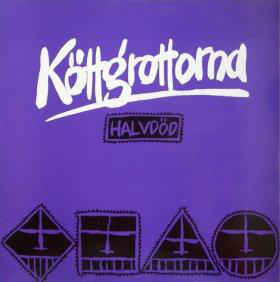
Köttgrottorna - "Halvdöd" (1987)


Köttgrottorna (The meat caves) have long been among the elite in Sweden's punk scene. The band was formed in 1983, the first two years their act was more towards musical comedy, but then the direction was changed to a more serious one. In 1987, the band consisted of Stefan "Mongo" Enger on bass and song, "Happy" Törnblom på drums, Janne Olsson on guitar and song and Guld-Lars on guitar. The latter had previously played in KSMB, another one of Sweden's more famous punk bands. The band still exists today, however as a trio as Guld-Lars passed away in 2015. Stefan "Mongo" happens to be my cousin, blood is thicker than water, so in today's post everything that is spelled objectivity or criticism has flown through the window. Today, everyone loves Köttgrottorna.


Halvdöd (Half-dead) was the band's second LP, and consists of a live-recorded half (side A), and a studio recorded half (side B). The live recording is from a concert in the ABF house in Jakobsberg, Stockholm. Personally, I like the studio-recorded side best, even though the live concert also has its charm. Not surprisingly, the live recording is a bit rougher and more noisy in its sound, of course it's fast-paced and both the band and the audience seem to have fun. My favorite song from the concert is the closing number Människor Smakar Gott (Humans Taste Good), but all songs have their own beauty.

I prefer the studio recording because it contains a little more variety. It's not just straight on punk rock, bass-drums-guitar-song. It offers some slightly quieter songs, some keyboard / synth sneaks in etc. which gives more variation. The sound in the studio also appeals to me more, a bit more polished and controlled. All songs on the record are the band's own compositions except a cover of the Swedish artist Björn Afzelius' song Svarta Gänget (The Black Gang) on the B-side. Maybe Afzelius was flattered that the band recorded this song, but personally I think the band's own songs are of a higher standard. My own favorite from the studio is Ekonomimarsch I D-Dur (Economy March In D-Major).


So if you like punk, I think you should try to find this album. I've got my record from one of my uncles, since he no longer had a vinyl player, he let me choose freely in his collection. It was like Christmas Eve. The album displays the band in both a live and studio format, which is interesting. And few bands have such a bad ass bassist and singer like Köttgrottorna. Usually I'm not a punk lover, but for Köttgrottorna I make an exception.


Tracklist

Side A
1 Pendeltåg
2 Flyg Iväg
3 Undergångslåten
4 Jag, Idealist
5 I Väntan På Livet
6 Människor Smakar Gott

Side B
1 Hand I Hand
2 Svarta Gänget
3 Ekonomimarsch I D-Dur
4 Gråa Moln
5 Meatcave Army


Friday, October 20, 2017

When The Wind Blows (Soundtrack, 1986)


Another soundtrack that was acquired due to a connection to Pink Floyd, in the form of Roger Waters. This is also a cut-out, but otherwise quite different from the last post on music from Zabriskie Point. Even though Roger Waters' presence was the main reason for the purchase, other artists who contributed, David Bowie, Genesis and Paul Hardcastle (19 had been a big hit a few years earlier), also attracted. It seemed promising. Two more artists are found on the album, Squeeze and Hugh Cornwell, but hey were, ans still are, unknown to me.

Roger Waters gets the entire side B to spread out on, while the others have a song each on the first side. This of course means that side A runs away in quite different directions, while side B is more coherent. In general, I've never been in love with the album. On side A, it was just Genesis' The Brazilian I found groovy, an instrumental with a wonderfully bombastic refrain. Most people think Bowie's contribution is the highlight, the title song, but I've never fallen for it. The other songs, including Paul Hardcastle's, are nothing to get excited about, they're actually very boring. But I still like The Brazilian.


Waters suite on the B side is a bit more interesting. It's kind of one long song, divided into sub parts,  and resembles a lot Waters' other solo albums in sound and mood. However, it doesn't reach the same heights as Amused To Death or the latest, Is This The Life We Really Want ?. More at the same level as Radio K.A.O.S., which isn't regarded as his career highlight. It has a tendency to get a little boring in the long run, where quite bland passages sometimes are broken off by something more interesting, but these interruptions are a bit too short. This might probably be explained by the fact that it's a soundtrack, which purpose is to complement a movie. Without the movie, some of the music can be experienced as lacking structure. It's more of an atmosphere that's created. This is a record that hasn't been played a lot over the years, and it probably won't get much time on the turntable in the future. I appreciate the B side most, but since Waters' other solo albums are much better, there's no need to spin this on the stereo.

I haven't seen the movie. Apparently an English movie where the main characters are hand-drawn, while other objects are real.


Tracklist

Side A
1. David Bowie - "When the Wind Blows" 3:35
2. Hugh Cornwell - "Facts And Figures" (Hugh Cornwell) - 4:19
3. Genesis - "The Brazilian" 4:51
4. Squeeze - "What Have They Done?" 3:39
5. Paul Hardcastle - "The Shuffle" 4:16

Side B
Roger Waters And The Bleeding Heart Band
1. "The Russian Missile" - 0:10
2. "Towers of Faith" - 7:00
3. "Hilda's Dream" - 1:36
4. "The American Bomber" - 0:07
5. "The Anderson Shelter" - 1:13
6. "The British Submarine" - 0:14
7. "The Attack" - 2:53
8. "The Fall Out" - 2:04
9. "Hilda's Hair" - 4:20
10. "Folded Flags" - 4:51