Tuesday, May 17, 2011

Talking Heads – “Fear of Music” (1979)

Talking_Heads-Fear_Of_Music_b

I now and then heard the Talking Heads album Speaking in Tongues being played on the stereo in the house where I grew up, it was my older brother who owned it and it was a record I liked. If there was one person behind the name Talking Heads or ten-man-band, I had no idea. In my early self-centered teenage years, I thought because this record was the only one I had heard with TH, it was the only album they had made. This was so obvious I never even reflected on this idea. Imagine then my surprise when I as a 14-year-old visited the record store Tropez Records in Uppsala (Sweden) and found an ink black album with TH called Fear of Music. My world tumbled when I got the life-changing insight that Talking Heads, and thus probably many other bands, had a history! It was something of a shock and a new world, or many new worlds opened up. The wallet also had to open up. Damn!

As you often did in those days I listened to the record in the store and I thought it was fantastic. Especially the second track Mind blew my mind and I spontaneously felt that it was one of the best songs I've ever heard. Back home from the store and proudly showed my brother the new record. I remember how he lay on the living room floor and listened to the album in headphones. When he was done, he gave the album thumbs up and mentioned that he had really liked the song Memories can’t wait. It felt good that my brother, who had introduced TH in my life, also liked the album.

Fear of Music was Talking Head’s third album and Brian Eno was again the producer. The basics for the album was recorded with Eno for two days in drummer Chris Frantz’s and bassist Tina Weymouth’s loft in New York. The cover was designed by keyboardist/guitarist Jerry Harrison, he’s also the one who came up with the album’s title. Most songs were created by the band jamming together, however, the singer/guitarist David Byrne has got most of the credits concerning the songwriting. Byrne has written the texts except to the opening song I Zimbra. When the record was released it got a positive respons from the general public and critics.

Personally I think this is a very good album, one of Talking Heads best, if not the best. Just like the album cover the sound is relatively dark, it's not a depressing album but I can’t call it uplifting. There are not many records out there where all the songs are good, but Fear of Music is one of them. Almost. All tracks are of very high quality but if I must break it down to controlled enthusiasm and unconditional love the songs I Zimbra, Paper and Cities have always belonged to the B-team. Animals is the only song I’ve had a hard time with (except the last part which is fun). Other songs are gems. Heaven is the most "normal" song on the album and probably the only one who could work in the repertoire of a cover band playing at a 50th birthday party. Life During Wartime is a favorite of many fans and one of TH's more famous songs. Yeah, OK, that one could problably work in the reperiore of a cover band also.

Over the years, Fear of Music has received lots of top spots in lists like the best album of 1979, best album ever, the best album in the last 20 years, best album of the 70s, etc. (How many lists can be created anyway?).

Favorite Songs

Mind

Memories Can’t Wait

Air

Electric Guitar

Drugs


Tracklist

Side A

1. I Zimbra 3:09

2. Mind 4:13

3. Paper 2:39

4. Cities 4:10

5. Life During Wartime 3:41

6. Memories Can't Wait" 3:30

Side B

1. Air 3:34

2. Heaven 4:01

3. Animals 3:30

4. Electric Guitar 3:03

5. Drugs 5:10


Memories can’t wait


Air

Wednesday, May 4, 2011

Prince – “Controversy” (1981)

Prince_-_Controversy

“People call me rude / I wish we all were nude / I wish there was no black and white / I wish there were no rules”

Some albums in people's collections have been purchased for one or two songs, sometimes you’ll also find other great songs as an extra plus. Other albums have been purchased because the buyer assumes it will be a good album, but maybe just finds one song that’s agreeable and lets it go round and round on the turntable. If I remember correctly, I got this record from my brother, I’m not sure how he had got it. I was somewhere in the first half of my teens and ever since the day I got the album I have always associated it with a single song - the title track Controversy.

Yes, this relationship has been so tight that when I now listen to the album, it's almost as if I hear it for the first time. I found the song Controversy quite nice while the others, at the first listening in my teens, were rather boring and uninteresting. Therefore, I never played them again. Instead I let the song Controversy start and finish this LP. It was OK to treat records you hadn’t bought with your own money this way, if I had paid for it myself, I had probably forced myself to listen to the other songs as well. I also suspect that my brother didn’t pay for this album, which made it even easier. It should also be added that, after a year in my possession, a number of drops of acetone ended up on the B side which left this side more or less ruined. Those things happen, right? I can now listen side B thanks to the Internet and the Web site Grooveshark.

Controversy was Prince's fourth album and his most political up to that date. It sounds typical Prince - many parts syntheseizer, a few parts funky bass lines, a few pinches of falsetto vocals here and there, of course some love dripping ballads and a few sexual hints (how about the subtle Jack U Off?). When I listen to it now it still feels pretty bland. Prince's love ballads have never been my favorite genre and I've always been ambivalent to his relatively dry funky sound with lots of syntheseizers. On many of his records, including this one, there is much one can put aside, but here and there there are a few gems hidden. When listening to the record before writing this post, I realized that it was actually another song I sometimes listened to, Annie Christian. It had fortunately survived the acetone attack and just as in my younger years I still find the song quite good with a somewhat different sound from the rest of the album.

Prince went on a tour following the release of Controversy, among other things, he opened a number of concerts in the United States for the Rolling Stones. A combination that, at least in my world, seems a bit strange.

In addition to the above mentioned exceptions, I am not particularly fond of this album so it will problably continue a quite life in my record collection.


Favorite Songs

Controversy

Annie Christian


Tracklist

Side A

1 Controversy 7:14

2 Sexuality 4:20

3 Do Me, Baby 7:47


Side B

1 Private Joy 4:25

2 Ronnie, Talk To Russia 1:48

3 Let's Work 3:57

4 Annie Christian 4:21

5 Jack U Off 3:12

Prince and Youtube seems to be a bad combination at the moment (of course it is the artist who doesn’t feel like giving people the opportunity to listen to his songs for free). Therefore no cool Youtube links. Greedy and disappointing, to say the least, and bad PR in today's world of digital media. And this from an artist who probably has more money than he will ever be able to spend (like Youtube clips would get someone to lose income).

Wednesday, April 27, 2011

Wire – “The Ideal Copy” (1987)

the-ideal-copy

Once upon a time there was no Internet, at least not among the common man and in the shape it has today. It was in the second half of the 80's and I was in my mid-teens. I heard a really good song on the radio and as usual at that time you had to listen carefully when the song was coming to its end if you wanted to know who performed it. If you missed this golden moment you were done for, then you'd better hope that soon you would hear the song again and then manage to get the artist’s name. As a consequence of this, some songs had an almost mythical status, at least in my life. Songs that you’d heard only once, which were fantastic but you had no idea who performed them and therefore had no chance of getting. But that’s another story, in this case, I got the name of the band - Wire, a totally unknown band to me, but one that I decided to investigate further.

I visited the legendary music store Musikörat (the Musical ear) ear in Uppsala, Sweden, and asked to listen to The Ideal Copy. I soon realized it was the second track Ahead I had heard on the radio, a nice kick-ass song with a lot of energy on a record that was quite different from most other records I owned. Although there was not total love at first sight, I bought the album.

Wire was founded in 1976 in London and released their first album the following year. Initially, the band is considered to have belonged to the punk scene, but they developed their sound constantly, and on their second and third album, they had moved quite far away from the classic punk sound. Some call what they did in the 70s for art-punk, others believe that they can not be categorized. 1980-85 the band took a break and The Ideal Copy was their first full length album after this break (and thus their fourth LP). And as before, the band had developed a new sound.

Wires history was something I knew nothing about and was blissfully unaware of until much later in my life (thanks to the birth of Internet). As mentioned, it was not unconditional love at first sight, and it never was. Sure, it held a relatively strong attraction to me and I found quite a lot of joy in the album, but the great passion never appeared. There was always something in the music that made me a bit ambivalent towards it. I think it had something to do with the relatively dark sound of the record and the singer's voice, which for some reason raises a neurotic feeling inside me. I never got curious about Wire's earlier creations and let the band remain an unknown entity in my record collection. However, this album was played extensively during my teenage years although it has become increasingly less played as more years have passed by.

The feelings from my teenage years have persisted. There is still something in the sound and vocals that makes me a bit uncomfortable, although many tracks are quite enjoyable. I still like the earlier mentioned Ahead, Feed Me and Ambitious are other highlights. Side A has always been my favorite and I think the B-side, apart from the opening song, always have been relatively boring.

A difference today is that a curiosity has been awoken concerning Wire's earlier works. That I now know more about them is problably a factor in this. Thanks to the internet it’s now very easy to explore new music and at the top of my list are Wire's second and third album. It can be mentioned that Wire has released its twelfth album this year (2011).

Finally, it must also be mentioned that The Ideal Copy was the first album also released on the then new format DAT, so if not for anything else, it should go down in history for that. After listening through The Ideal Copy for the first time in many years before this post, I think it will get more playing time from now on.

Favorite Songs

Ahead

Feed Me

Ambitious


Tracklist

Side A

1. The Point Of Collapse 3:18
2. Ahead 4:52
3. Madman's Honey 4:23
4. Feed Me 5:50

Side B

1. Ambitious 4:00
2. Cheeking Tongues 2:02
3. Still Shows 4:00
4. Over Theirs 5:18


Saturday, April 16, 2011

David Byrne – “Music For the Knee Plays” (1985)

David_Byrne_-_Music_For_The_Knee_Plays

As a teenager I listened a lot to Talking Heads, an interest which automatically led to the exploration of the individual band members and their solo efforts. David Byrne was the lead singer of Talking Heads and its main songwriter, while in the band he did some solo records, Music For The Knee Plays was his third.

The sad story of when I bought this album is unfortunately one that was repeated far too often. I found it in a record store, listened to it there and didn’t think it was any good. But because I liked Talking Heads, I had the compulsive idea that David Byrne's solo records also must be good. In addition, I dared not tell the staff at the store I wasn’t interested, what would they think? What if they were hurt or disappointed? So I put my own feelings aside, let my insecurity guide me and bought the album. There was perhaps also a feeling that I would win some respect from the store by buying an album with David Byrne, isn’t it kind of intellectual? In this way, I came home with a record I really didn’t want. The positive side on this coin is that my musical explorations were extended and I got to know some music I wouldn’t have come across otherwise. I was around 15 years old when I bought this LP.

Music For The Knee Plays is music Byrne composed for Robert Wilson's opera The Civil Wars: A Tree Is Best Measured When It Is Down. Other composers in this opera included Philip Glass, Gavin Bryars and others. The opera was composed for the Olympic Games in Los Angeles 1984. The idea was that six different composers from six different countries would compose the different musical parts of the opera. The various pieces would then be performed in each country and finaly be fused together in an epic performance for an entire day during the Olympics. For various reasons this ultimate performance was never done and still haven’t been done until this day.

The music on the album is inspired by The Dirty Dozen Brass Band, a brass band from New Orleans. In practice this means that there are only wind instruments and percussion on the record in addition to Byrne's voice, which sticks to talking (no singing). This was too unusual for me and I had a hard time get into the groove. I really tried to like the album but besides a few songs, it was not the easiest album to deal with. Allmusic.com describes the album as "brass-led marches that sound like an art school has landed on Bourbon Street." So you understand that a 15-year-old Markus had to struggle a bit. Byrne has written most of the songs, some are traditional and arranged by Byrne and / or others.

When I now listen to the album, I think pretty much the same. It's not really my kind of music and I probably woudn’t have bought it today (well, maybe if I found it for less than five dollars).The songs I thought were good as a teenager, I still like, the feeling is the same for those I didn’t like. Yet I’m glad I bought the album, maybe I can gain some respect by owning a vinyl album with David Byrne. Or do people just see me as a weirdo?


Favorite Songs

Tree

Theadora Is Dozing


Tracklist

Side A

1. Tree (Today Is An Important Occasion) 4:02

2. In The Upper Room 3:35

3. The Sound Of Business 6:15

4. Social Studies 4:52

5. (The Gift Of Sound) Where The Sun Never Goes Down 2:34

6. Theadora Is Dozing Trad 2:59


Side B

1. Admiral Perry 5:32

2. I Bid You Goodnight 2:51

3. I've Tried 3:24

4. Winter 6:11

5. Jungle Book 3:38

6. In The Future 6:35


Tuesday, April 12, 2011

Steve Hackett – “Till We Have Faces” (1984)

Hackett

Another one of all those albums I bought because of a cover that attracted me (and a price that attracted me, SEK 19 (3 USD) if I remember correctly). As the reader can see the cover obviously promises music that can’t be anything but fantastic. In any case, I believed that when I, as a 15.year-old, bought this LP at the shop BK-records in Uppsala (Sweden). My expectation was simply great druggy music. A feeling of disappointment came over me immediately when I listened to the record the first time, the opening song was OK, but otherwise it was not at all what I had hoped for. The production and the songs felt cheap and I understood that the man named Steve Hackett must have been a nobody in the music industry that had never reached any fame. Till We Have Faces was probably the only album he had been allowed to do. At the same time this was a small source of joy and pride, it's always fun to own an obscure album with an equally obscure artist. This gives you an air of a connoisseur and inspires a certain respect.

Today I know the truth is entirely different. Hackett started his international career as a guitarist in the legendary band Genesis, where he was a member until 1977. Then he began his long and relatively successful solo career. Till We Have Faces was his eighth solo album and recently his 34th was released - Live Rails. He has also had time to play in the "super group" GTR. In other words, he was far from being a nobody that no one except me knew about.

The record is mainly recorded in Brazil with mostly Brazilian musicians. This has given it a certain (small) vibe of so-called world music, some even claim that Hackett with this record was the first to use such influences on a rock album. However, there were some other bands that had already done so (eg Police), nevertheless, he was one of the pioneers and thus must be said to have been relatively progressive in his musical adventures.

Perhaps the fact that I now know what an authority Hackett is affects me, but when I today listen to the album, I think it’s much better than I did as a teenager. Oh, you think it's because of my maturity as a human being and a greater depth in musical knowledge? Well, thank you, that’s a compliment. Still, some songs have a sound that I don’t like and which also seems a bit outdated. Myopia feels too much like bad heavy metal (although it happens some interesting things in the middle of the song), a drum machine ruins the song What's My Name and the blues ballad Let Me Count The Ways is just boring. In these songs the sound and production have too much an 80s feel over it, in my opinion. But other tracks have mysteriously changed character from boring to beautiful, from boring to jazzy, from boring to groovy or from boring to complex. It is not impossible that this album will make a comeback on my turntable, and maybe finally get the respect it problably deserves.

Finally, the album’s cover, which I today don’t particularly like, is painted by Hackett’s then-wife, Kim Poor. The painting is named Silent Sorrow in Empty Boats from a song by Genesis. Kim has painted most of Hackett’s album covers.

The opening song Duel used to be my favorite as a teenager, mostly thanks to the howling guitar / synth (I still don’t know if it’s only synth or both) but this has changed. Today's favorite song is the ballad Taking the Easy Way Out. I may have become romantic as a 38-year-old (even though I know my wife would just laugh at me if I said so).


Tracklist

Side A

1. Duel 4:50

2. Matilda Smith-Williams Home For The Aged 8:04

3. Let Me Count The Ways 6:05

4. A Doll That's Made In Japan 3:57


Side B

1. Myopia 2:56

2. What's My Name 7:05

3. The Rio Connection 3:24

4a. Taking The Easy Way Out 3:49

4b. When You Wish Upon A Star 0:51


Friday, April 1, 2011

Brian Eno – “Music For Films” (1978)

eno

If there is any man who can wear the epithet Mr. Ambient it is Brian Eno. He has created a series of records containing this form of music, sound, art, atmospheres or however you’d like to define it. He is considered to be the man who coined the term ambient for “low-volume music designed to modify one's perception of a surrounding environment.". In practice - very quiet, music/sounds with a lot of silence that often is best used as a background.

His musical career began, however, as a member of Roxy Music in 1971. There he played the keyboard and was responsible for other electronical devices such as mixer decks and tape recorders. In 1973 he quit the band due to difficulties in the relationship with singer Bryan Ferry, another reason is also said to be that Eno was tired of the rock star life. Instead, he began a solo career that has included many of his own albums, but also a lot of production work for other artists such as Talking Heads, U2 or James. In addition, he has worked on a variety of albums with many different artists, an involvement which sometimes has been a collaboration. Such collaborations have been with David Bowie, John Cale, Robert Fripp and others. His career is no doubt impressive and Eno is considered to be one of the most important figures in the last decades of music. And yes, he is the man who composed the 3½ second song you heard when you started Windows 95. Despite that, his career is currently still ongoing.

I bought Music For Films when I was around 17 years old, I was familiar with the name Brian Eno thanks to my older brother who had a record or two with him. I had also heard an Eno album in school at a music lesson, in which a substitute teacher was preaching while some soft piano sounds could be heard in the background (yes, it was the same substitute teacher who had played Atom Heart Mother for us, for the reader with a good memory). I liked the atmosphere the music created but was not sure of its name, but I had understood that it was "music for" something. Off to the record shop and guess what I found if not Music for Films. I bought it (even though it was full price), went home and heard that it was not the same record that I had heard in the music class. Luckily, this was also in the same genre so my disappointment was eased significantly. I realized later that it was Eno's album Music for Airports that the teacher had played.

As a teenager, it happened from time to time that I listened through the whole album in my headphones, although I had a tendency to become very sleepy and frankly a bit bored. More often, I put it on as a soothing background sound when I for example made my homework. In fact, many believe that ambient music is not supposed to be focused upon, but should instead be somewhere in the background. In other words, my listening to it in headphones was the wrong way to go.

It's hard to write some short and easily understood words about the music because it is fairly amorphous and atmospheric. However, it can be said that the songs are relatively short on Music for Films, between one and four minutes. In addition, a lot of different instruments are used, not only synthesizers, tape loops and/or piano that seems to be the case in some of Eno’s more minimalistic ambient records. On these records the songs are also longer, sometimes one song fills the whole album. In this way, Music For Films differs from many other Eno creations within this genre. It can be mentioned that musicians like Robert Fripp, John Cale and Phil Collins participates on the album.

Some of the music on the album was recorded in 1976 and was sent to various film directors for possible use as soundstrack. When the album was released in 1978 Eno commented the new songs as a "possible use as soundtracks to 'imaginary' films '. In the end, a few tracks from the album do appear in some films; A Better Tomorrow, (Sparrow Fall (1)), Jubilee (Slow Water), Sebastiane and Breathless (Final Sunset), and Rock 'n' Roll High School (M386 and Alternative 3).

Today, I would become too bored if I would sit still and really listen to an album like Music For Films. But the album works well as a mean to create a calm and thoughtful mood, why not when you’re cleaning the house? The music has a tendency to neutralize all forms of stress, in other words, this kind of music must be good for your health. Who knows, one day you might get it prescribed.

Allmusic.com reveals the secret of the album:

“…and another film student who had tried out some of the cues: "this is the worst music for films ever. These cues don't synch to anything." However, the second filmmaker unintentionally discovered the essence of Music for Films -- the 18 pieces here are little films, stimulating the visual part of one's brain and thus fulfilling their promotional purpose.”


Tracklist

Side A

1. M386

2. Aragon

3. From the Same Hill

4. Inland Sea

5. Two Rapid Formations

6. Slow Water

7. Sparrowfall (1)

8. Sparrowfall (2)

9. Sparrowfall (3)


Side B

1. Quartz

2. Events in the Dense Fog

3. There Is Nobody

4. A Measured Room

5. Patroling Winte Borders

6. Task Force

7. Alternative 3

8. Strange Light

9. Final Sunset


Thursday, March 24, 2011

Pink Floyd - ”A Nice Pair” (1973)
A nice pair.jpg

A Nice Pair is a double album consisting of Pink Floyd's first two albums, The Piper At The Gates Of Dawn (1967) and A Saucerful of Secrets (1968). These albums show to some extent a different side of PF than the one we might associate with records like Dark Side Of The Moon or Wish You Were Here. Instead of the later sweeping concept albums, we here find a psychedelic playfulness, especially on the first LP. The sound on these albums are also less timeless – you here that you visit the 60s.

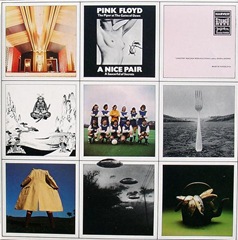
The cover was created by Hipgnosis and is made up by a total of 18 small images of proposed, but unused, cover images to the album.

The Piper At the Gates of Dawn may well be described as Syd Barrett's high point in his career. On this record, he has written all of the songs except one, usually alone, sometimes together with the others. He is also the lead singer on almost all of the songs, some would go as far as to call this a Syd Barrett album.

The music on this album can not be called anything but psychedelic, and I experience it as a psychedelia with a dark vibe. If that is because of the sound, the harmonies, the lyrics or the knowledge of Syd's subsequent fate, I can not answer. An acquaintance of mine who was a heavy user of cannabis described this as his favorite album to listen to while under the influence of the drug. He used the term "unconscious music" as he felt that the music to some extent opened the door to that forbidden part of the brain. Now, you might want to believe him or not, but I am inclined to agree with him. These are not songs about peace, love & understanding with druggy bluesfueled jam sessions, instead they are typical Syd Barrett songs with lyrics that may be viewed as playful or, as in my and my friends' case, dark and strange. The sound is also darker than the usual 60s psychedelia which on the whole provides a record that somehow gets into your head. My acquaintance was convinced that PF knowingly created such music in some inscrutable purpose, personally, I am not as convinced.

The recording took place in Studio 3 at EMI Studios while the Beatles were there and recorded Sgt. Peppers Lonely Hearts Club Band. Producer was Norman Smith, who had been studioengineer at all the Beatles recordings up to Rubber Soul. PF's drummer Nick Mason describes that the recording of the album went smoothly and was very effective. Norman Smith on the other hand, remembers the recording as "a hell", and this was aimed at both the recording itself and the band members' musical talents.

On the album there are a few examples of PF's early fondness of strange musical journeys and / or experiments. These are strange sounds (noises) in a relatively unstructured form that might be fun to create but not so fun to listen to. Instellar Overdrive is an example of this. If I had the records on CD, I would click "Skip" when you got to this and similar songs.

The songs on the album, however, are overall really good, with a few exceptions, and every one has its own unique characteristics. But I can’t escape the feeling that there is something strange with the record, even a playful song like Bike ("I've got a bike, you can ride it if you like, it's got a basket, a bell that rings and things to make it look good ...") has some sort of dark vibe. This makes the LP both fascinating and leaves some kind of wonder, a wonder about why it leaves you wondering. Don’t ask me to elaborate on this, it’s hard to put the finger on it and my subconscious doesn’t easily turn into the form of written words.

Allmusic.com writes about music: ”...giving the impression of chaos and confusion lurking beneath the bright surface. The Piper at the Gates of Dawn successfully captures both sides of psychedelic experimentation -- the pleasures of expanding one's mind and perception, and an underlying threat of mental disorder and even lunacy.”

nice_pair2

On the second album, A Saucerful Of Secrets, the band seems to have matured. The songs have become more serious with a different tone. Syd's mental health had deteriorated dramatically and he contributed only with one song, the closing song Jugband Blues. PF had because of his increasingly confused and difficult behavior picked up a new member of the band, David Gilmour. This man was to become an important part of PF's future creations. For various reasons the band had not gotten around to get rid of Syd, despite all the difficulties he created. This means that this is the only album with PF where all five members took part. There are many stories about Syd concerning strange interviews, bizarre stage performances or sudden physical (or mental) absence from this time. The ones interested can Google his name to share his story.

The title track of A Saucerful Of Secrets is again one of these long instrumental songs that maybe should be called sound art. But I notice a difference from the similar projects of the first album, the tone and the mood feels more controlled and the band seems to have an idea what they want with these sound experiments. They seem to have some sort of goal.

Rick Wright has contributed with a couple of songs of which I find Remember a day the finest. He also sings lead vocals on four of the LPs eleven tracks, and does backing vocals on the title track, making it the only PF album where he sings on more songs than anyone else. The Roger Waters creation Corporal Clegg, is a song many people believe is an attempt to imitate Syd Barrett's more playful way of creating songs, but a failed one. Personally, I have always liked this song as it is more classic psychedelia than many other things they did. Believe it or not, but Nick Mason sings on this track which makes this the only album where all five members contribute with vocals (even if all members, then four, contributed with their voices on Meddle). Waters also contributes on this album with the classic Set the Controls for the Heart of the Sun, a favorite of mine that still holds true. This track is also the only song that all five members take part in, which makes it unique in the PF catalogue. I have always liked Syd's song contribution, Jugband Blues, a song that leaves you somewhat sad from knowing that this was the last thing he contributed to Pink Floyd. After this it just went downhill for him.

Just like on their first album, most of the songs have a dark side that makes me want to use the term "unconscious music" again. And yes, my acquaintance also played this album a lot when he used cannabis and has described the dark inner journeys he made. But unlike their first album there are songs here, or parts of songs, which lack this dark vibration, such as Corporal Clegg or the Rick Wright song See-Saw. If this is good or bad thing I don’t know.

Pink Floyd had from the start put a heavy focus on their stage shows which usually offered a lot of visual stimuli. Their light show was always evocative, and were made with lamps, spotlights and projectors. Large parts of their audience of course made the experiences even more thrilling with the help of drugs, but the members themselves were never very fond of these substances (except for Syd). Drummer Nick Mason describes in his autobiography Inside Out: A Personal History of Pink Floyd, that in addition to a joint from time to time at leisure time (“which everyone smoked in those days "), they used no drugs. And certainly not during a concert. According to Nick the members of the band always identified themselves more as musicians than as hippies or spokesmen for the psychedelic movement.

In conclusion, I have always liked these records and they have been played a lot in my home and best of all - they are still great. The reader may wonder why I bought this double album instead of the two separate records. The truth is that I didn’t really know so much of PFs earlier creations at the time of the purchase (I was 18, I think) and simply didn’t know that this record was actually two.


Favorite Songs

Matilda Mother

Remember a Day

Set the Controls for the Heart of the Sun


Tracklist

Side A
  1. "Astronomy Domine" (Barrett) – 4:14

  2. "Lucifer Sam" (Barrett) – 3:07

  3. "Matilda Mother" (Barrett) – 3:08

  4. "Flaming" (Barrett) – 2:46

  5. "Pow R. Toc H." (Barrett / Roger Waters / Richard Wright / Nick Mason) – 4:26

  6. "Take Up Thy Stethoscope and Walk" (Waters) – 3:05

Side B
  1. "Interstellar Overdrive" (Barrett / Waters / Wright / Mason) – 9:41

  2. "The Gnome" (Barrett) – 2:13

  3. "Chapter 24" (Barrett) – 3:42

  4. "The Scarecrow" (Barrett) – 2:11

  5. "Bike" (Barrett) – 3:21

Side C
  1. "Let There Be More Light" (Waters) – 5:38

  2. "Remember a Day" (Wright) – 4:33

  3. "Set the Controls for the Heart of the Sun" (Waters) – 5:28

  4. "Corporal Clegg" (Waters) – 4:13

Side D
  1. "A Saucerful of Secrets" (David Gilmour / Waters / Wright / Mason) – 11:57

  2. "See-Saw" (Wright) – 4:36

  3. "Jugband Blues" (Barrett) – 3:00